

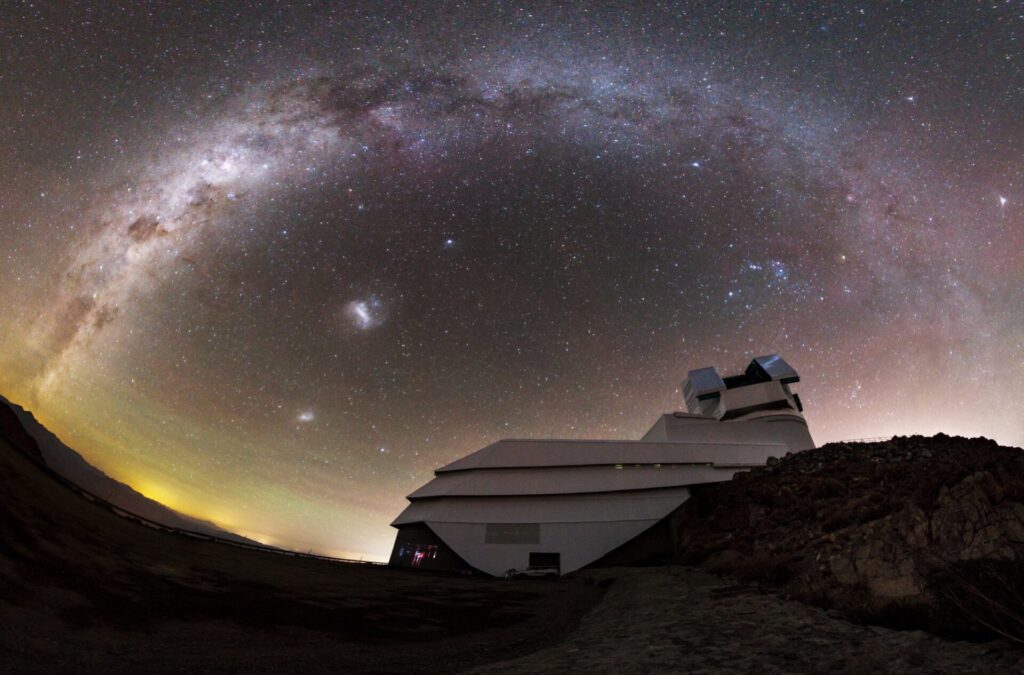
Action! The Vera C. Rubin Observatory Begins the Largest Cosmic Film Ever Made
The ten-year Legacy Survey of Space and Time (LSST) officially began on Monday 29 June 2026, marking the start of a new era in astronomy and astrophysics to which scientists from LAPP are contributing.
Observing the Visible Sky for 10 Years
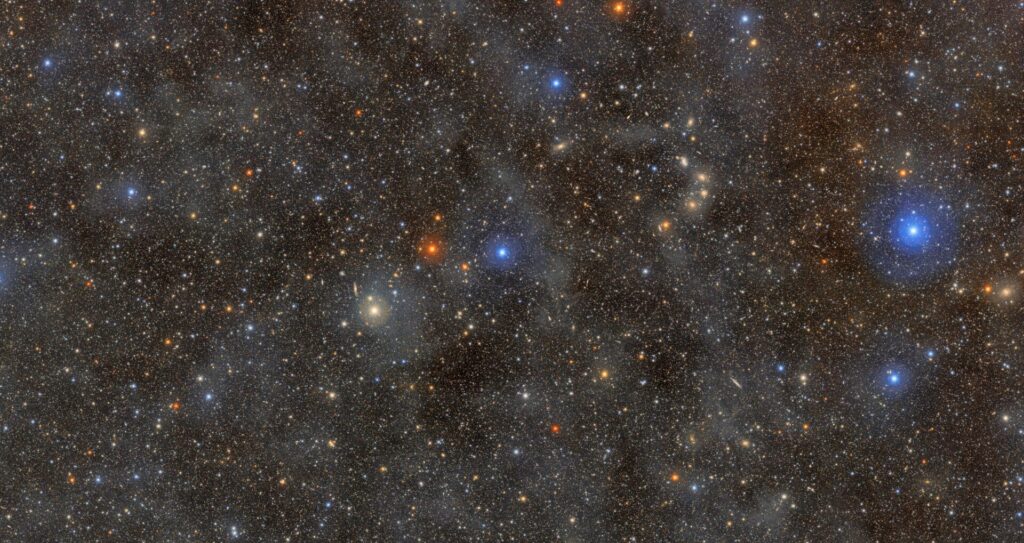
After months of ultra-precise adjustments to its giant astronomical camera and all its components, the Vera C. Rubin Observatory has launched its flagship initiative: the Legacy Survey of Space and Time (LSST). This ten-year programme aims to conduct the most ambitious astronomical observation ever undertaken. Night after night, the observatory will tirelessly scan the visible sky from the Southern Hemisphere, revisiting each region every three days or so to capture a new, ultra-high-definition photograph. By repeating this process over a decade, it will gradually create a true film of everything that changes or moves in this part of the Universe. At the same time, it will provide a deep view, formed by combining individual images, revealing the large-scale cosmic structures.
This milestone marks 25 years of studies and construction led by an international collaboration, to which several CNRS teams have contributed.
This long-awaited step is the culmination of years of effort by thousands of people worldwide. It follows the “Rubin First Look” event, which celebrated the observatory’s first light in June 2025, along with the final commissioning work, an operational review of the telescope, and the launch of the alert stream.
The World’s Largest Camera
LThe Vera C. Rubin Observatory combines exceptional light-gathering power, the ability to rapidly scan the night sky, and a wide field of view. Its 3,200-megapixel camera—the largest digital camera in the world—now captures a new detailed image approximately every 40 seconds. Thanks to this speed and sensitivity, Rubin operates as a unified, perfectly calibrated system, capable of detecting faint objects and fleeting phenomena every night with remarkable reliability and consistency.
The observatory will highlight on a vast diversity of cosmic phenomena: variable stars, supernova explosions, fossil traces of galaxies, and will also search for clues to the mysteries of dark energy and dark matter. Furthermore, it may uncover entirely new phenomena that we have never observed before. Some cosmic events unfold slowly, unpredictably, or with incredibly low frequency—making a ten-year observation campaign essential.
LAPP: Essential Expertise in Instrumentation and Data Analysis
From Annecy, the LAPP teams play a key role in testing and optimising the telescope and the readout of the LSST camera’s sensors. Their goal is to achieve the level of precision required for the most advanced scientific analyses.
With its computing expertise, LAPP is one of the laboratories involved in processing and analysing the enormous data stream generated by the LSST camera. This process will enable tens of billions of stars and galaxies to be classified so that they can be studied by scientists.
LAPP researchers are particularly interested in measuring cosmological parameters by counting galaxy clusters based on their mass and redshift.
Unravelling the Mysteries of the Universe
By revisiting each point in the sky approximately 800 times over a decade, the data from the Vera C. Rubin Observatory will provide the scientific community with deep observations rich in temporal data. These are essential for uncovering subtle events, capturing moving objects, and studying the accelerated expansion of the Universe.
Not only will Rubin help unravel the mysteries of the distant Universe, but it is also the most powerful observatory ever built for studying our solar system. By capturing around a thousand images every night, Rubin will create a detailed inventory of the solar system, including millions of asteroids and comets. In just one and a half months, during the initial optimisation campaigns, Rubin discovered over 11,000 previously unobserved asteroids, including 33 near-Earth objects and 380 trans-Neptunian objects.
Rubin will also open new perspectives for multi-messenger astronomy, which involves studying cosmic events using multiple signals such as light, gravitational waves, and cosmic rays. The observatory’s rapid, colour-rich observations of transient phenomena—such as stellar explosions, active black holes (accreting matter), and collisions between compact objects—will enable telescopes worldwide to follow up on these fleeting events.
Each night, Rubin collects around ten terabytes of data and generates up to seven million alerts signalling changes in the night sky. These alerts are sent to alert brokers—automated systems that sort and classify these changes so scientists can act quickly.
Once the LSST survey is complete, the final dataset will contain billions of objects and trillions of measurements, all accessible through regular data releases. This is the first time such a vast amount of astronomical data will be made available to such a wide audience, paving the way for new types of discoveries—both for scientists and the general public. Rubin invites anyone in the world to use its data and explore the dynamic Universe in a revolutionary way.
The LSST Project
The LSST project is led by the U.S. Department of Energy (DOE) and the National Science Foundation (NSF). The SLAC National Accelerator Laboratory is responsible for building the observatory’s camera. As a long-standing partner of the CNRS, SLAC called on the organisation’s scientists to help design and build the camera’s robotic filter changer. This system automatically changes the camera’s colour filters—5 to 15 times per night—each weighing between 24 and 38 kg. By measuring the amount of light celestial objects emit and comparing images taken through different filters, it is possible to precisely determine their physical properties, such as their nature, temperature, or distance.
CNRS laboratories will use data from the LSST survey to carry out cosmological analyses of dark energy and dark matter, as well as studies on galaxy formation, the Milky Way and small bodies in the solar system such as asteroids.
The IN2P3/CNRS Computing Centre receives and stores all the images recorded daily by the Rubin Observatory’s camera. It provides its computing expertise and infrastructure to process 40% of the images locally. A catalogue listing the physical properties of some 17 billion stars and 20 billion galaxies—extracted from these images using sophisticated algorithms—will be progressively built, representing the most comprehensive catalogue of celestial objects ever created.
More information
- Vera C. Rubin Observatory website: https://rubinobservatory.org/
- Press release CNRS Nuclear & Particles: https://www.cnrs.fr/en/press/vera-c-rubin-observatory-unveils-first-images-sky-obtained-worlds-largest-camera
- Noirlab Press Release: https://noirlab.edu/public/news/noirlab2616/
- LSST at LAPP : https://www.lapp.in2p3.fr/recherche/vera-c-rubin-observatory
- Cover image: In this photograph taken in February 2026, the Rubin Observatory (NSF–DOE) observes the Chilean night sky above Cerro Pachón, beneath the dazzling sight of our galaxy, the Milky Way, and its largest neighbouring galaxies, the Magellanic Clouds. Credit: NSF–DOE Rubin Observatory/NOIRLab/SLAC/AURA/P. Lago