

ATLAS
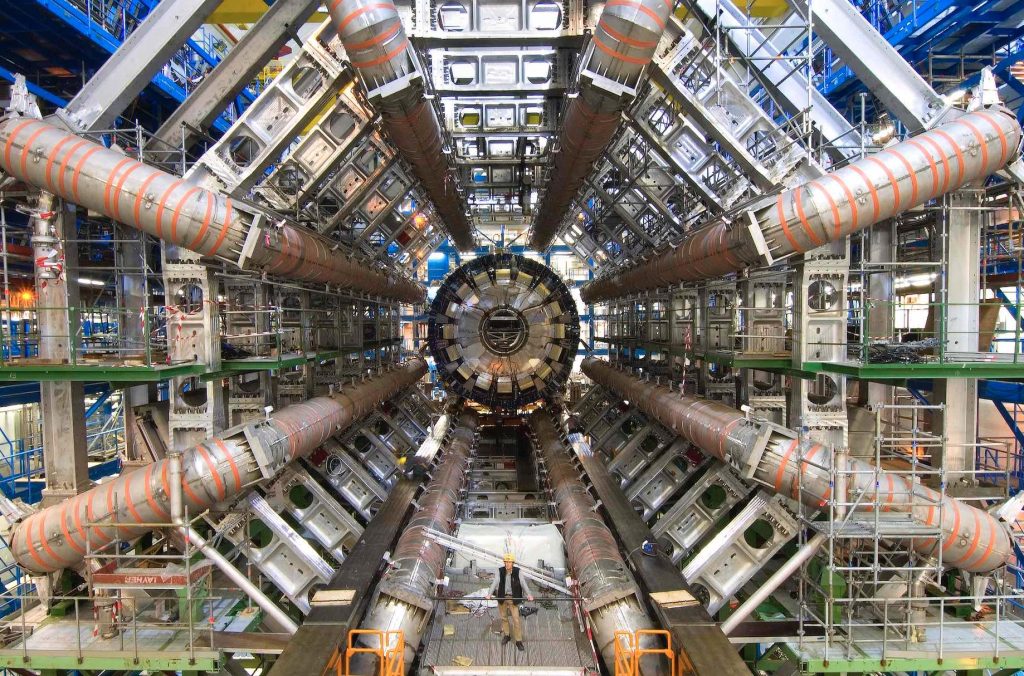
The first run of the LHC, with proton-proton collisions at 7-8 TeV, led to the discovery of the Higgs boson at the end of 2012. The analysis of the data from the second run, from 2015 to 2018 at 13 TeV, deepened the measurement of the properties of this particle, without revealing any new physical effects not predicted by the Standard Model (SM).
In the following years, the integrated luminosity of 140 fb-1 allowed ATLAS to explore new study channels and improve the precision of measurements of existing channels, whether it be measuring rare processes in the electroweak sector of the Standard Model, finely characterizing the properties of the Higgs boson and its couplings to other particles, or searching for direct manifestations of new resonances.
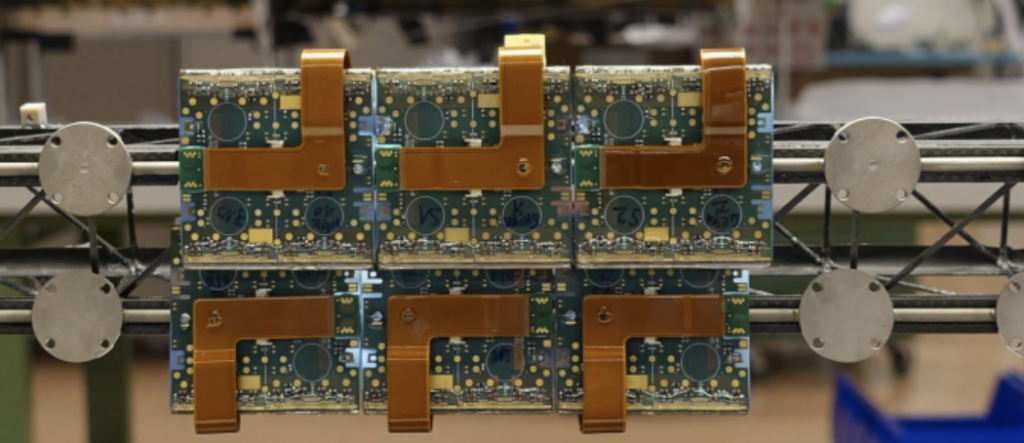
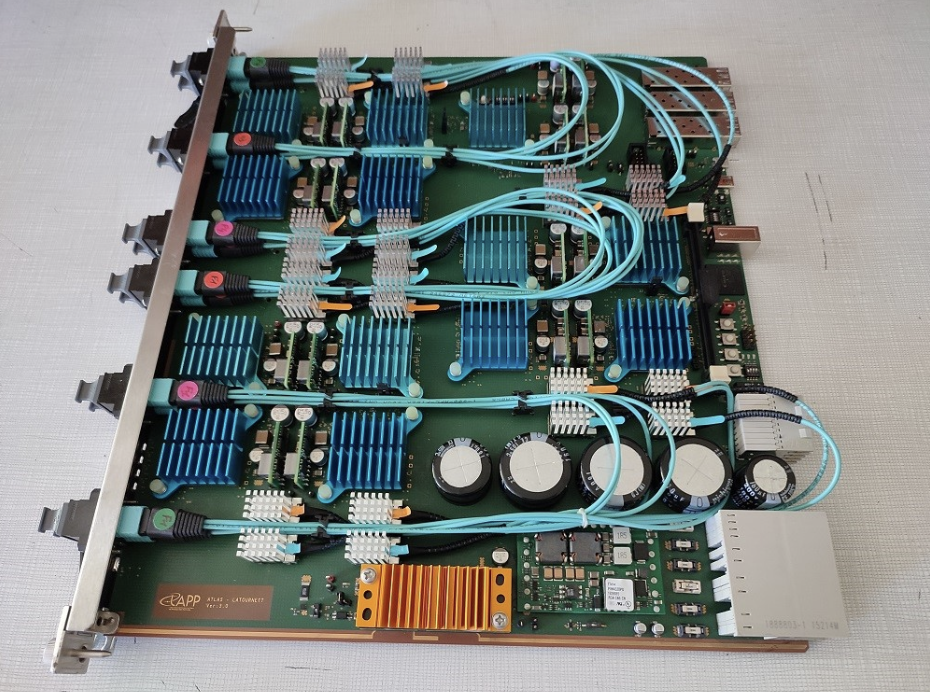
In parallel with these analyses, the preparation of various upgrades for the ATLAS detector continued. With extensive expertise in mechanics and electronics, gained during the design, construction, and installation of the ATLAS liquid argon electromagnetic calorimeter (1995-2005), the LAPP group led the design, construction, installation, and commissioning of a new data transmission electronic board for the trigger acquisition system, LATOME. This allowed the transition from an analog to a digital trigger system, thus increasing the bandwidth and the rate of interesting collisions, to cope with the increased luminosity of the LHC.
Furthermore, a second upgrade is planned for 2027 during which the entire electronics of the calorimeter will need to be replaced. The group is working on developing new solutions for the calibration and digital readout electronics of the calorimeter. Having participated in the construction and installation of the IBL (Insertable B-Layer) pixel detector in 2013 and 2014, the group then contributed to the design and prototyping studies of a new internal pixel tracking detector for the high-luminosity phase of the LHC (HL-LHC), scheduled for 2027. The group is preparing for the fabrication of this detector in the coming years.
Activities of LAPP
Since the beginning of the ATLAS experiment, LAPP has played a key role within the Collaboration, marked by the discovery in 2012 and subsequent study of the properties of the Higgs boson. In addition to its research efforts aimed at detecting signals of unknown physics, the group contributes to the operational management of the detector. It is also involved in the design, fabrication, and deployment of new detectors to accommodate the increased luminosity expected in future data taking periods.
Completed PhD theses and Habilitation
- Iro Koletsou – Soutenance de HDR – 20 dec. 2023 – 14h – Un guide vers la diffusion des bosons vecteurs
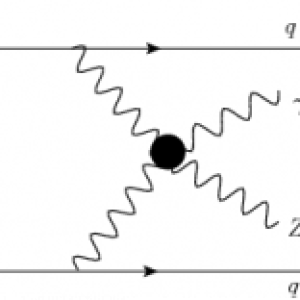
- Gitanjali Poddar – Soutenance de thèse – 6 oct. 2023 – Étude de la diffusion Z-photon et mise à niveau de la carte de calibration électronique à argon liquide avec le détecteur ATLAS
- Luka Selem – Soutenance de thèse – 27 sep. 2022 – Mesure des états de co-polarisation des bosons de jauge en production de paire WZ au LHC avec le détecteur ATLAS
- Luca Franco – Soutenance de thèse – 13 jan. 2022 – Mesures de précision des propriétés du boson de Higgs via la désintégration en deux photons avec l’expérience ATLAS
- Mohamed Belfkir – Soutenance de thèse – 15 sep. 2021 – Recherche de production de paires de bosons de Higgs au collisionneur LHC (CERN) : Premier test du potentiel de Higgs et recherche de nouvelle physique
- Louis Portales – Soutenance de thèse – 1 oct. 2020 – Observation de la production WZjj electrofaible, et études sur la suppression des jets d’empilement avec le détecteur ATLAS
- Olympia Dartsi – Soutenance de thèse – 3 oct. 2019 – Recherche de la production électrofaible de paires Zγ et mesure de la section efficace différentielle de production de Zγ en association avec deux jets dans l’ATLAS expérience du LHC
- Pierre Barroca – Soutenance de thèse – 30 sep. 2019 – Modélisation du refroidissement CO2 du détecteur à pixels ITk dans ATLAS
- Peter Johannes Falke – Soutenance de thèse – 20 sep. 2019 – Recherche de nouvelles résonances a haute masse dans l’état final dilepton et calibration du démonstrateur pour l’upgrade Phase-1 du calorimètre électromagnétique dans l’expérience ATLAS
- Saskia Moenig (Falke) – Soutenance de thèse – 17 sep. 2019 – Mesure des proprietes du boson de Higgs avec les donnees du Run 2 collectees par l’experience ATLAS
Collaboration
The ATLAS experiment, conducted at the Large Hadron Collider (LHC) at CERN, represents one of the largest international scientific collaborations. Over 3,000 scientists, engineers, and researchers from more than 180 institutions across over 40 countries participate in this endeavor. This diversity underscores the global scope of the cooperative effort aimed at understanding the fundamental phenomena of particle physics.
France plays a central role within the ATLAS collaboration. The CNRS (Centre National de la Recherche Scientifique) and IN2P3 (Institut National de Physique Nucléaire et de Physique des Particules) are key players in this involvement. Renowned laboratories such as LPNHE, IJCLab, and CPPM actively contribute to the design, construction, and operation of the ATLAS detector.
Actualités
- All
- Science
LAPP physicists have played an important role in the discovery of a new measurement of one of the rarest
On 30th of March 2010, the Large Hadron Collider at CERN provided the first proton-proton collisions with a total energy
The third LHC data-taking period, called Run 3, will start in 2021. ATLAS detector is currently undergoing maintenance and improvement